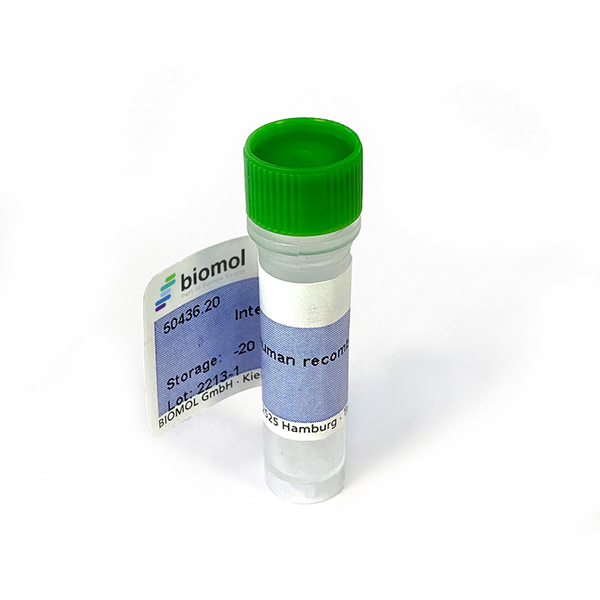
Cytokine that in its homotrimeric form binds to TNFRSF1A/TNFR1, TNFRSF1B/TNFBR and TNFRSF14/HVEM. In its heterotrimeric form with LTB binds to TNFRSF3/LTBR. Lymphotoxin is produced by lymphocytes and cytotoxic for a wide range of tumor cells in vitro and in vivo. (www.uniprot.org) Produced in E.coli. Single, non-glycosylated, polypeptide chain containing 171 amino acids. The ED50 as determined by the cytolysis of murine L929 cells in the presence of Actinomycin D is < 0.05ng/ml.
Introduction Lymphotoxin alpha, a member of the tumor necrosis factor family, is a cytokine produced by lymphocytes. LTA is highly inducible, secreted, and exists as homotrimeric molecule. LTA forms heterotrimers with lymphotoxin-beta which anchors lymphotoxin-alpha to the cell surface. LTA mediates a large variety of inflammatory, immunostimulatory, and antiviral responses. LTA is also involved in the formation of secondary lymphoid organs during development and plays a role in apoptosis.
Description Tumor Necrosis Factor-b Human Recombinant (Lymphotoxin) produced in E.Coli is a single, non-glycosylated, polypeptide chain containing 172 amino acids and having a molecular mass of 18645 Dalton. The TNF-b is purified by standard chromatographic techniques.
Source Escherichia Coli.
Physical Appearance Sterile Filtered White lyophilized (freeze-dried) powder.
Formulation Lyophilized protein with no additives.
Solubility It is recommended to reconstitute the lyophilized Tumor Necrosis Factor-beta in sterile 18M?-cm H2O not less than 100µg/ml, which can then be further diluted to other aqueous solutions.
Stability Lyophilized Tumor Necrosis Factor-b although stable at room temperature for 3 weeks, should be stored desiccated below -18°C. Upon reconstitution TNF-b should be stored at 4°C between 2-7 days and for future use below -18°C. For long term storage it is recommended to add a carrier protein (0.1% HSA or BSA). Please prevent freeze-thaw cycles.
Purity Greater than 98.0% as determined by(a) Analysis by RP-HPLC. (b) Analysis by SDS-PAG.
Biological Activity The ED50 as determined by the cytolysis of murine L929 cells in the presence of Actinomycin D is < 0.05ng/ml, corresponding to a Specific Activity of 20,000,000IU/mg.
Protein content Protein quantitation was carried out by two independent methods 1. UV spectroscopy at 280 nm using the absorbency value of 1.082 as the extinction coefficient for a 0.1% (1mg/ml) solution. This value is calculated by the PC GENE computer analysis program of protein sequences (IntelliGenetics).
2. Analysis by RP-HPLC, using a calibrated solution of TNF-b as a Reference Standard.