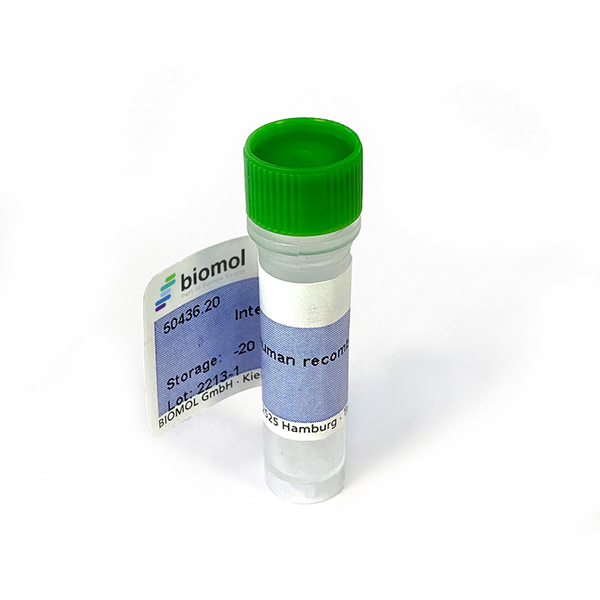
The insulin-like growth factors, isolated from plasma, are structurally and functionally related to insulin but have a much higher growth-promoting activity. May be a physiological regulator of [1-14C]-2-deoxy-D-glucose (2DG) transport and glycogen synthesis in osteoblasts. Stimulates glucose transport in rat bone-derived osteoblastic (PyMS) cells and is effective at much lower concentrations than insulin, not only regarding glycogen and DNA synthesis but also with regard to enhancing glucose uptake. (www.uniprot.org) Produced in E.coli. Single, non-glycosylated, polypeptide chain containing 70 amino acids. The ED50, calculated by the dose-dependant proliferation of murine BALBC 3T3 cells (measured by H-thymidine uptake) is < 1.0 ng/ml.
Introduction The somatomedins, or insulin-like growth factors (IGFs), comprise a family of peptides that play important roles in mammalian growth and development. IGF1 mediates many of the growth-promoting effects of growth hormone (GH; MIM 139250). Early studies showed that growth hormone did not directly stimulate the incorporation of sulfate into cartilage, but rather acted through a serum factor, termed sulfation factor, which later became known as somatomedin (Daughaday et al., 1972). Three main somatomedins have been characterized: somatomedin C (IGF1), somatomedin A (IGF2; MIM 147470), and somatomedin B (MIM 193190) (Rotwein, 1986; Rosenfeld, 2003).
Description Insulin-Like Growth Factor-I Human Recombinant produced in E.Coli is a single, non-glycosylated, polypeptide chain containing 70 amino acids and having a molecular mass of 7655 Dalton. IGF-I is purified by proprietary chromatographic techniques.
Source Escherichia Coli.
Physical Appearance Sterile Filtered White lyophilized (freeze-dried) powder.
Formulation The protein was lyophilized with no additives.
Solubility It is recommended to reconstitute the lyophilized IGF-1 in sterile 18M?-cm H2O not less than 100µg/ml, which can then be further diluted to other aqueous solutions.
Stability Lyophilized Insulin-Like Growth Factor-1 although stable at room temperature for 3 weeks, should be stored desiccated below -18°C. Upon reconstitution IGF1 should be stored at 4°C between 2-7 days and for future use below -18°C. For long term storage it is recommended to add a carrier protein (0.1% HSA or BSA). Please prevent freeze-thaw cycles.
Purity Greater than 95.0% as determined by(a) Analysis by RP-HPLC(b) Analysis by SDS-PAGE.
Biological Activity The ED50, calculated by the dose-dependant proliferation of murine BALBC 3T3 cells (measured by 3H-thymidine uptake) is < 1.0ng/ml, corresponding to a specific activity of 1,000,000U/mg. For most in-vitro applications, IGF-I exerts its biological activity in the concentration range of 0.2-20 ng/ml.
Protein content Protein quantitation was carried out by two independent methods: 1. UV spectroscopy at 280 nm using the absorbency value of 0.502 as the extinction coefficient for a 0.1% (1mg/ml) solution. This value is calculated by the PC GENE computer analysis program of protein sequences (IntelliGenetics). 2. Analysis by RP-HPLC, using a calibrated solution of IGF1 as a Reference Standard.
References
1.Title:Oestrogen-induced androgen insufficiency results in a reduction of proliferation and differentiation of spermatogonia in the zebrafish testis.
Publication: Journal of Endocrinology (2009) 202, 287–297.
Application: support spermatogenesis in an androgen-independent manner (Leal et al. 2006)
2.Title:Suppression of Anoikis by SKP2 Amplification and Overexpression Promotes Metastasis of Esophageal Squamous Cell Carcinoma . Publication:doi: 10.1158/1541-7786.MCR-08-0092 Mol Cancer Res January 2009 7; 12 Link:http://mcr.aacrjournals.org/content/7/1/12.full
3.Title:MECHANISMS OF BIOMATERIAL MEDIATED FIBROTIC RESPONSES AND STRATEGIES TO IMPROVE TISSUE REACTIONS TO BIOMATERIAL IMPLANTS. Publication:THE UNIVERSITY OF TEXAS AT ARLINGTON May 2010 Link:http://dspace.uta.edu/bitstream/handle/10106/49 18/Thevenot_uta_2502D_10646.pdf?sequence=1