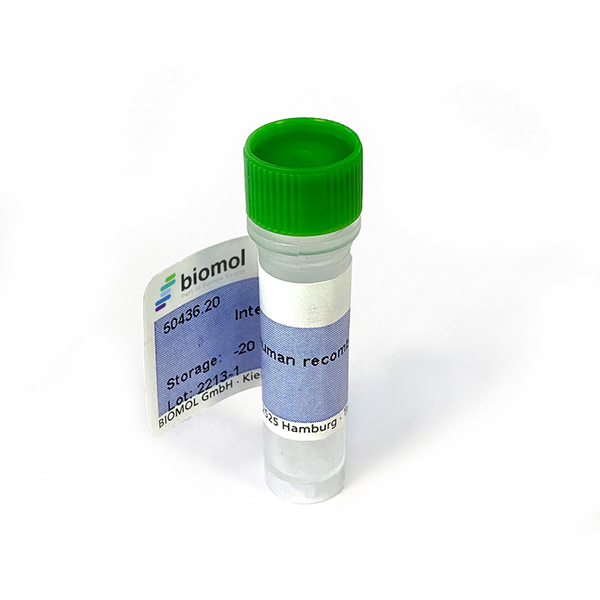
Involved in the suppression of bile acid biosynthesis through down-regulation of CYP7A1 expression, following positive regulation of the JNK and ERK1/2 cascades. Stimulates glucose uptake in adipocytes. Activity requires the presence of KLB. (www.uniprot.org) Human recombinant FGF19 produced in E.coli is a single, non-glycosylated, polypeptide chain containing 195 amino acids and having a molecular mass of 21.8 kDa. The FGFs are a family of more than 20 small (approx. 17?26 kDa) secreted peptides. The initial characterization of these proteins focused on their ability to stimulate fibroblast proliferation. This mitogenic activity was mediated through FGF receptors (FGFRs) 1, 2, or 3. A fourth closely related tyrosine kinase receptor (FGFR4) was able to bind the FGFs but did not lead to a mitogenic response. FGFs modulate cellular activity via at least 5 distinct subfamilies of high-affinity FGF receptors (FGFRs). FGF-19, has been shown to cause resistance to diet-induced obesity and insulin desensitization and to improve insulin, glucose, and lipid profiles in diabetic rodents. Since these effects, at least in part, are mediated through the observed changes in metabolic rates, FGF-19 can be considered as a regulator of energy expenditure. FGF-21 is preferentially expressed in liver, but an exact knowledge of FGF-21 bioactivity and its mode of action have been lacking to date. FGF-21 is a potent activator of glucose uptake on adipocytes, protects animals from diet-induced obes
Cat-Nr: 97315.25
Menge: 25 µg
Preis: 170 €
UniProt ID: O95750 (Protein knowledgebase) Synonyms Fibroblast growth factor 19, FGF-19, FGF19. Introduction The FGFs are a family of more than 20 small (~17–26 kDa) secreted peptides. The initial characterization of these proteins focused on their ability to stimulate fibroblast proliferation. This mitogenic activity was mediated through FGF receptors (FGFRs) 1, 2, or 3. A fourth closely related tyrosine kinase receptor (FGFR4) was able to bind the FGFs but did not lead to a mitogenic response. FGFs modulate cellular activity via at least 5 distinct subfamilies of high-affinity FGF receptors (FGFRs): FGFR-1, -2, -3, and -4, all with intrinsic tyrosine kinase activity and, except for FGFR-4, multiple splice isoforms, and FGFR-5, which lacks an intracellular kinase domain. There is growing evidence that FGFRs can be important for regulation of glucose and lipid homeostasis. The overexpression of a dominant negative form of FGFR-1 in ? cells leads to diabetes in mice, which thus implies that proper FGF signaling is required for normal ? cell function and glycemia maintenance. FGFR-2 appears to be a key molecule during pancreatic development. Moreover, FGFR-4 has been implicated in cholesterol metabolism and bile acid synthesis. FGF-19, has been shown to cause resistance to diet-induced obesity and insulin desensitization and to improve insulin, glucose, and lipid profiles in diabetic rodents. Since these effects, at least in part, are mediated through the observed changes in metabolic rates, FGF-19 can be considered as a regulator of energy expenditure. FGF-21 is preferentially expressed in liver, but an exact knowledge of FGF-21 bioactivity and its mode of action have been lacking to date. FGF-21 is a potent activator of glucose uptake on adipocytes, protects animals from diet-induced obesity when overexpressed in transgenic mice, and lowers blood glucose and triglyceride levels when therapeutically administered to diabetic rodents. Description FGF19 Human Recombinant produced in E.Coli is a single, non-glycosylated, polypeptide chain containing 195 amino acids and having a molecular mass of 21.8 kDa. The FGF-19 is purified by proprietary chromatographic techniques. Source Escherichia Coli. Physical Appearance Filtered white lyophilized powder. Formulation Filtered (0.4 µm) and lyophilized from 1mg/ml in 1x PBS, pH 7.4. Solubility Add deionized water to a working concentration approximately 0.5 mg/ml and let the lyophilized pellet dissolve completely. Stability Lyophilized FGF-19 Human Recombinant although stable at room temperature for 3 weeks, should be stored desiccated below -18°C. Upon reconstitution Fibroblast Growth Factor-19 should be stored at 4°C between 2-7 days and for future use below -18°C. For long term storage it is recommended to add a carrier protein (0.1% HSA or BSA). Please prevent freeze-thaw cycles. Biological Activity The ED50 as determined by the dose-dependent stimulation of the proliferation of balb/c 3T3 cells is 100-150ng/ml. Purity Greater than 95.0% as determined by: (a) Analysis by RP-HPLC. (b) Analysis by SDS-PAGE. Amino acid sequence MRPLAFSDAG PHVHYGWGDP IRLRHLYTSG PHGLSSCFLR IRADGVVDCA RGQSAHSLLE IKAVALRTVA IKGVHSVRYL CMGADGKMQG LLQYSEEDCA FEEEIRPDGY NVYRSEKHRL PVSLSSAKQR QLYKNRGFLP LSHFLPMLPM VPEEPEDLRG HLESDMFSSP LETDSMDPFG LVTGLEAVRS PSFEK.
zurück
|
Weitere Produkte für dieses Protein:Antibodies
Plasmids/Vectors
Chemicals & More
Primers
Cytokines
- FGF-19 (human) (rec.), Kat #: AG-40A-0186-C010
- FGF-19 (human) (rec.), Kat #: AG-40A-0186-C050
- FGF-19 (human):Fc (human) (rec.), Kat #: AG-40A-0187-C010
- FGF-19 (human):Fc (human) (rec.), Kat #: AG-40A-0187-C050
- FGF-19 (human, rec.) (His), Kat #: AG-40A-0111-C010
- FGF-19 (human, rec.) (His), Kat #: AG-40A-0111-C050
- Fibroblast Growth Factor 19 (FGF19), human recombinant (rHuFGF19), Kat #: F4212-91B.25
- Fibroblast Growth Factor-19 (FGF19), human recombinant (rHuFGF19), Kat #: 97315.1
- Fibroblast Growth Factor-19 (FGF19), human recombinant (rHuFGF19), Kat #: 97315.5
- Fibroblast Growth Factor-19, His Tag, human recombinant (rHuFGF-19-His), Kat #: 94912.1
- more
Products for: FGF - fibroblast growth factor
|