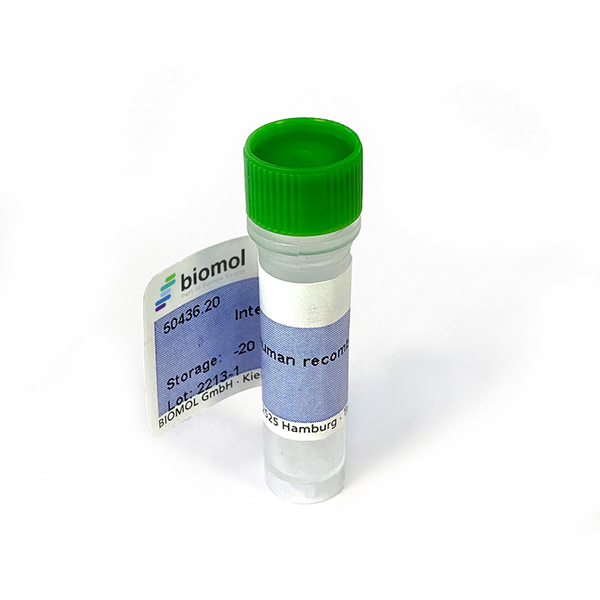
The heparin-binding fibroblast growth factors play important roles in the regulation of cell survival, cell division, angiogenesis, cell differentiation and cell migration. They are potent mitogens in vitro. (www.uniprot.org) Produced in Sf9 insect cells as a single, glycosylated, polypeptide chain containing 140 amino acids. This protein functions as a modifier of endothelial cell migration and proliferation, as well as an angiogenic factor.
Cat-Nr: 94956.10
Menge: 10 µg
Preis: 170 €
UniProt ID: P05230 (Protein knowledgebase) Synonyms HBGF-1, ECGF-beta, FIBP, FGFIBP, FIBP-1, ECGF, ECGFA, GLIO703, FGF1, FGF-a. Introduction Acidic fibroblast growth factor is a member of the fibroblast growth factor (FGF) family. FGF family members possess broad mitogenic and cell survival activities, and are involved in a variety of biological processes, including embryonic development, cell growth, morphogenesis, tissue repair, tumor growth and invasion. This protein functions as a modifier of endothelial cell migration and proliferation, as well as an angiogenic factor. It acts as a mitogen for a variety of mesoderm- and neuroectoderm-derived cells in vitro, thus is thought to be involved in organogenesis. Three alternatively spliced variants encoding different isoforms have been described. The heparin-binding growth factors are angiogenic agents in vivo and are potent mitogens for a variety of cell types in vitro. There are differences in the tissue distribution and concentration of these 2 growth factors. Description Fibroblast Growth Factor-1 Human Recombinant (FGF-1) produced in Sf9 insect cells is a single, glycosylated, polypeptide chain containing 140 amino acids and having a molecular mass of 15803 Dalton. The FGF-a is purified by proprietary chromatographic techniques. Source Baculovirus. Physical Appearance Sterile Filtered liquid formulation. Formulation The sterile protein solution (1.8mg/ml) contains 20mM Tris HCl pH=7.9, 100mM KCl, 0.2mM DTT and 20% glycerol. Stability Fibroblast Growth Factor-acidic although stable at 4°C for 3 weeks, should be stored desiccated below -18°C. For long term storage it is recommended to add a carrier protein (0.1% HSA or BSA). Please prevent freeze-thaw cycles. Purity Greater than 95.0% as determined by(a) Analysis by RP-HPLC. (b) Analysis by SDS-PAGE. Amino acid sequence The sequence of the first five N-terminal amino acids as determined and was found to be Met-Phe-Asn-Leu-Pro. Biological Activity The ED50, calculated by the dose-dependant proliferation of BAF3 cells expressing FGF receptors (measured by 3H-thymidine uptake) is <10 ng/ml, corresponding to a specific activity of 100,000IU/mg.
zurück
|
Weitere Produkte für dieses Protein:Antibodies
- Anti-FGF1 (N-term), Kat #: WA-AP6379a.20
- Anti-FGF1 (N-term), Kat #: WA-AP6379a
- Anti-FGF1, CT (Heparin-binding Growth Factor 1, HBGF-1, Acidic Fibroblast Growth Factor, aFGF, Beta-endothelial Cell Growth Factor, ECGF-beta, FGFA), Kat #: F4210-05B.100
- Anti-FGF1, NT (Heparin-binding Growth Factor 1, HBGF-1, Acidic Fibroblast Growth Factor, aFGF, Beta-endothelial Cell Growth Factor, ECGF-beta, FGFA), Kat #: F4210-05.100
siRNA
Plasmids/Vectors
Chemicals & More
Cytokines
- Fibroblast Growth Factor acidic, human recombinant (rHuFGF-acidic), Kat #: 50440.50
- Fibroblast Growth Factor acidic, human recombinant (rHuFGF-acidic), Kat #: 50440.1
- Fibroblast Growth Factor acidic, human recombinant (rHuFGF-acidic), Kat #: 50440.10
- Fibroblast Growth Factor acidic, human recombinant (rHuFGF-acidic-Sf9), Kat #: 94956.2
- Fibroblast Growth Factor acidic, human recombinant (rHuFGF-acidic-Sf9), Kat #: 94956.1
Peptides
Products for: FGF - fibroblast growth factor
|